
On April 1, 2026, four astronauts strapped into NASA’s Orion spacecraft, lifted off from Kennedy Space Center, and arced toward the Moon. Eleven days later, they splashed down safely in the Pacific. Artemis II marked the first crewed flight beyond low Earth orbit since Apollo 17 in 1972 — and the crew traveled farther from Earth than any human ever has, eclipsing a record that had stood for more than half a century.
We watched the launch the way a lot of Americans did — a little misty-eyed, a little goosebumpy, a lot proud. But around the Atlas shop floor, it landed a little differently. Because somewhere in the long, layered chain of work that made Artemis II possible — behind the speakers, behind the amplifiers, behind the testing chambers — there was sheet metal that came off our floor.
Not the rocket. Not the capsule. Not anything anyone in mission control would ever see. But in some small part, our hands got to play a role in this — and we are honored.
This is Atlas in Space, revisited.
How a Sheet Metal Shop Ends Up in the Artemis Story
Spacecraft don’t get to space without first surviving everything that happens on the way to space — and few moments are more violent than the seconds after liftoff. The acoustic energy generated by a launch vehicle’s engines is loud enough to shake hardware apart at the seams. Before any spacecraft leaves the launch pad, it has to be tested against that punishing acoustic environment.
That’s the job of direct field acoustic testing (DFAT). Massive arrays of high-powered speakers surround the spacecraft and recreate the 140-decibel sonic onslaught of a real launch — without ever putting the hardware on a rocket.
Building those speaker arrays is a specialized world. It takes the engineers who design the testing systems, the company that builds the high-powered amplifiers that drive them, and the team that integrates everything for aerospace customers. Atlas sits a few links back in that chain — quietly. We’re the shop that fabricates the amplifier racks that drive the speakers that test the spacecraft that carry the humans.
That’s a lot of “thats.” But it’s a chain we’re proud to be part of.


Custom Carts for the Hardware That Tests the Hardware
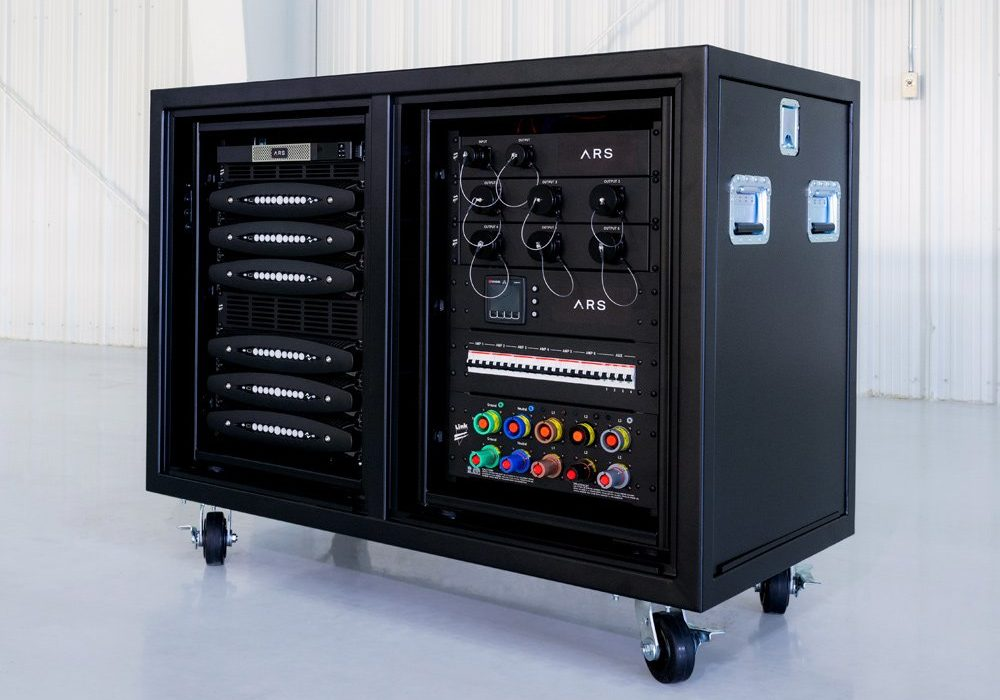
Atlas’s contribution to acoustic testing doesn’t stop at the racks. We also build the custom carts that move and position the amplifier systems on the test floor — precision-engineered to roll into place, lock down, and stay put while everything around them is doing its level best to break.
What goes into an Atlas-built DFAT cart:
- Precision and Mobility: Built to exact specifications for secure transport and placement of sensitive testing equipment.
- Durability: Designed to withstand the rigorous, repeating conditions of an acoustic test environment.
- Custom Design: Tailored to integrate seamlessly into the customer’s testing workflow — no two builds are the same.
Hardware That’s Actually Been to Space
Most of our aerospace work happens firmly on the ground — building the equipment that tests the equipment that goes up. But some of the metal that’s come off the Atlas shop floor has gone significantly farther. Into orbit, in fact, aboard the International Space Station.
We fabricated the protective housing for the Spaceborne Computer — a project demonstrating that advanced supercomputing can operate reliably in microgravity, through radiation, and across the wild power fluctuations of low Earth orbit. The housing had to survive a 17,500-mph ride to orbit and gravitational forces 2.8 times those on Earth during launch, and then keep doing its job for the long haul.
At last count, that piece of Atlas-built hardware has orbited Earth more than 8,900 times, racking up roughly 229 million miles alongside the ISS. The Atlas logo is still up there, intact, after the journey.
For the full story behind that build, take a look at our deeper write-up: Pioneering Supercomputing in Space.
Atlas in Space — to scale
Where Atlas hardware has actually been — and how far Artemis II went
On this scale, the International Space Station sits less than a fingertip from Earth — and Atlas-built hardware lives there. The Artemis II crew traveled 1,011× farther, beyond the Moon and back, helped along the way by Atlas-tested acoustic hardware.
Why This Matters to Us
We’re not the company in the photo at the launch pad. We’re not in the press releases. We don’t get the mission patches.
But on April 11, 2026, when the Artemis II crew splashed down safely after traveling farther from Earth than any human ever has — eclipsing a record that had stood since Apollo 13 — we got to feel a quiet kind of pride that’s hard to describe. The work that comes off our shop floor is precise, durable, and unglamorous. And every now and then, it ends up being a small part of something genuinely historic.
That’s why we do this.
Trusted Hands for the Aerospace Industry
From amplifier racks and custom DFAT carts, to supercomputing enclosures that have logged hundreds of millions of orbital miles, Atlas Manufacturing thrives on solving challenges for the aerospace and defense industries. Each component reflects our commitment to precision, quality, and a willingness to be the unseen part of someone else’s mission.
If you’re building something that has to survive a launch — or just something that has to be built right the first time — contact us today. We’d be honored to play a small part in your mission, too.
